fixed : This file sever will not allow any additional users to log on

Question :

I got this error “This file server will not allow any additional users to log on, please try again later” when I tried to access files that were on my network, but not on my Mac itself.

How can I fix this ?

Answer :

You can get this error when trying to connect to either another Mac or a Time Capsule in your network. The solution depends on the type of ‘server’ you are trying to connect to.

-A-

On a Mac running a normal (non-server) version of MacOSX, only 10 clients can be connected at the same time. If you get this error, despite the fact that you have less than 10 clients connected, try this :

– on the Mac you want to connect to, open the Terminal.app and type this command :

sudo defaults write /Library/Preferences/com.apple.AppleFileServer idleDisconnectOnOff -bool YES

– then press RETURN and you will be asked for your password

– type your password, press RETURN, quit the Terminal.app and you’re done (please note that the cursor will not move while typing your password in Terminal.app)

– whenever you want to undo (or reverse) this action, follow the same routine, but use this command :

sudo defaults write /Library/Preferences/com.apple.AppleFileServer idleDisconnectOnOff -bool NO

-B-

If you get this error message when connecting to a Mac and you need to have more than 10 clients connected, try this :

– upgrade the version of MacOSX you’re running (on the Mac you want to connect to) to the server-version of MacOSX, as OSX Server can handle an unlimited number of clients ; you can get the latest version of OSX Server in the Mac App Store

-C-

If you are trying to connect to a Time Capsule and you get this error message, the problem is something completely different. The Time Capsule can handle up to 50 clients at the same time, so chances of running into that limit in a regular household are low. But, the average internet provider has a limit of only 10 concurrent internet connections on it’s modem at the same time, so if you get this error when trying to connect to a Time Capsule, the 10 internet connections limit will probably be the cause. So try this :

– startup the AirPort Utility on your Mac

– click on the Time Capsule icon so the ‘info balloon’-window will open

– click on the “Edit”-button

– in the window that opens, click the “Network”-tab/button

– at “Router Mode:” select “DCHP and NAT”, so not “Off (Bridge Mode)”

– then click on the “Network Options…”-button

– in the window that opens, at “IPv4 DHCP Range:” select a range of IP-addresses that is different from your internet modem’s IP-range. So, if your internet modem’s IP-range is 192.168.1.xxx select an IP-range like “192.168.2.2 to 200” and click the “Save”-button

– in the next window, click the “Update”-button

– then, back in the ‘info balloon’-window of your Time Capsule, at “status” you will get “Double NAT” with an error mark (yellow dot) next to it… so, click on the “Double NAT”-text and in the pulldown-menu that opens, select “Ignore”

…that’s it !

Enjoy !

😉

Donate Button (MacManusNL)


fixed : hashtags making text unreadable in Excel

Question :

Somebody sent me an Excel spreadsheet in which some of the data is unreadable since it has been replaced by text consisting of hashtag signs only…

I’ve seen this happening before, and the remedy used to be just to broaden the column, since all number that are too large to fit their cell width are automatically made unreadable…

However, in this case, if I broaden the column width, some of the hashtag text will turned into readable numbers, but other hashtag text will remain, no matter how wide I make the column…

What is wrong ?

And how can I fix this ?


Answer :

This seems to be a problem with Excel for Windows files that are opened in Excel for Mac (possibly more specifically with data copied or converted from another application into Excel on a Windows-PC). So PC-users will not be warned on forehand that their Excel output is not suited for use on Macs…

Fixing it turns out to be rather simple (but annoying) :

• open the file in Excel for Mac

• select the cells that are effected (or preferably even the entire column), then go to “Format” in the top menu bar

• from the dropdown-menu that appears, select “Cells…” and a window entitled “Format Cells” will open

• make sure the “Number”-tab is selected and make sure that you select “Number” or “General” from the list (make sure that it is something else than what was previously selected ; anything seems to be okay, as long as it is not “Accounting”)

• no return to your spreadsheet to check if the hashtag texts have disappeared (if not : try again)

That’s it !

Enjoy !

😉

Donate Button (MacManusNL)

fixed : custom Quartz-filters are not available system-wide

Question :

In the past, I used to create my own custom Quartz-filters in ColorSync Utility, and they were instantly available system-wide in MacOSX. Now, in OSX 10.8 Mountain Lion and OSX 10.9 Mavericks ( and OSX 10.10 Yosemite and OSX 10.11 El_Capitan ), I don’t have access to my Quartz-filters anymore…

What is wrong ? And how can I fix this ?

Answer :

In the latest versions of OSX [*], there seems to be a bug preventing OSX to find Quartz-filters stored outside of the ‘official’ “Filters”-folder that is inside the “Library”-folder in the “System”-folder… so, since all custom-made Quartz-filters are stored inside the “Filters”-folder that is inside the (invisible) “Library”-folder in the User’s “Home”-folder, your custom-made Quartz-filters are not found by OSX…

The solution is to just move them into the right (official) “Filters”-folder. [**]

(Yep, it’s that easy…)

For an in-depth step-by-step guide for doing so, follow the procedure outlined here.

NOTES :

[*] this bug was solved/removed with the introduction of macOS 10.12 Sierra

[**] put differently :

In all versions of OSX from OSX 10.8 Mountain_Lion up to OSX 10.11 El_Capitan,
new Quartz-filters created in Colorsync Utility are/were automatically saved in :
~/Users/[username]/Library/Filters/
But all other applications (including e.g. Preview) weren’t able to access or use them as they could only load Quartz-filters from :
~/System/Library/Filters/
and – only if you created the following folder manually – from :
~/Library/Filters/
So you had to manually move your custom Quartz-filters to :
~/Library/Filters/
to be able to use them in Preview.app and alike

Donate Button (MacManusNL)

fixed : use the Terminal to repair corrupt .sparsebundle-file

Question :

I have a corrupt .sparsebundle-file (a TimeMachine-backup file), that I would really like to fix, because there’s some files in there that I need.

I have tried using the Disk Utility app, but that didn’t work.

I also read that it should be possible to use the Terminal app to do this, but I’ve never used the Terminal app before, and I can’t find clear directions on how to do it…

What exactly should I do ?

Answer :

The Terminal app is not a regular OSX-application, it is a command-line tool (a.k.a. console) to program and reprogram in the underlings of OSX (more or less like the DOS-prompt in Windows). So, as you are going out of the ‘OSX comfort zone’ when you start using the Terminal app, you should beware since messing things up there can really mess up OSX, and lead to having to re-install OSX.

Having that said, here’s a step-by-step guide to fixing your .sparsebundle-file using the Terminal app :

– first, connect your backup-drive (the one with the broken .sparsebundle-file on it) to your Mac, using a USB- or FireWire-cable

note : if the backup-drive is inside a Time Capsule, you’ll probably be best of getting the harddrive out of the Time Capsule (as outlined in this iFixit How-To) and then temporarily hooking it up to your Mac using something like this SATA-to-USB connector (or an old USB-harddrive-enclosure). Even though this breaks the warranty on your Time Capsule, it’s probably the best solution since the direct USB-connection is much faster than the usual network-over-ethernet-connection… (and bringing the Time Capsule in to an Apple-dealer for repair, will definitely mean losing all your data, since that is part of the regular repair-policy… and bringing it to a specialized data-recovery company will cost more than buying a new Time Capsule)

– then, open the Terminal app (which can be found in the Utilities folder that is in the Applications folder)

– in the window that opens, you will see the name of your Mac followed by a colon (:) and a tilde (~), so if the name of your Mac is MacBook Pro, you will see :

macbook-pro:~

that is the “prompt”, when you see that, you can start typing the commands

note : some basic knowledge about working in the Terminal :

  1. each line of commands (a.k.a. “command line”) you type should be activated by pressing the ENTER-key
  2. as long as you do not see the prompt, the Terminal app is still busy executing your last command line
  3. the Terminal can not handle names with spaces in them, as spaces play an important roll in a command line ; they separate the subsequent commands given in one command line, e.g. if your backup-file’s name is MacBook Pro.sparsebundle, the Terminal app requires you to type is as MacBook\ Pro.sparsebundle or you can type the entire path to the file in quotation marks, like : “…/…/MacBook Pro.sparsebundle” (another option is to temporarily change the filename to one that has only letters and numbers in it)
  4. you don’t need to type the entire path to a file’s location in a command line manually, you can just drag-and-drop the file itself onto the command line and the entire path to the file will be automatically generated (a handy trick to prevent mis-typing)
  5. when typing your password in the Terminal, the cursor will not progress, so there will be no visual feedback whatsoever about what you’ve typed… so, type your passwords only with total focus on what you’re typing !
  6. ! BEWARE : be sure to double-check your typing when using the command line, as one mis-typed letter can generate an entirely different, unwanted outcome, screwing up your entire OSX installation !
  7. when working in Terminal app on a MacBook (Pro/Air), the advice is not to use an external keyboard, but the on-board keyboard

Now, when you see the prompt appearing, type this (followed by pressing the ENTER-key) :

admin$ sudo su –

Then, when you see the prompt appearing again, type this (followed by pressing ENTER) :

root# chflags -R nouchg [drag .sparsebundle-file here]

Then, at the next prompt, type this (and press ENTER) :

root# hdiutil attach -nomount -noverify -noautofsck [drag .sparsebundle-file here]

And at the next prompt, type this (and ENTER) :

root# tail -f /var/log/fsck_hfs.log

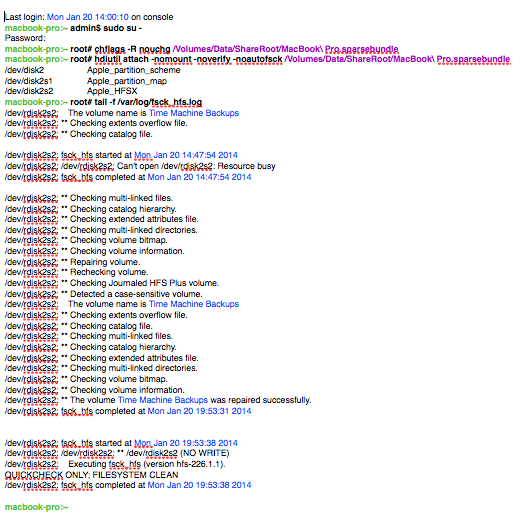
Look closely in this next file when you need to type what, and what the feedback should look like (kind of) :

  • bold green text = this is the command line prompt
  • bold black text = you should manually type exactly this text
  • bold purple text = drag-and-drop your .sparsebundle-file here, and your sparse bundle’s path will be displayed
  • black text = this text is generated by the Terminal, indicating what is busy and/or finished, and will be the same when your replicate this proces
  • blue text = what is displayed here depends on your specific situation
  • if problems are found, they will be listed in-between these lines, and it will also be indicated how it was fixed

console log sparsebundle repair

note : as you can see from the time-stamps in the picture, the entire process will take quite a long time to complete (it took nearly 6 hours to repair this harddisk – a 500GB harddrive that was temporarily taken out of a Time Capsule and connected via USB2.0)

so, from there on it’s wait, wait, wait, do something entirely different, wait (again), get a good night’s sleep… and wake up in the morning with a repaired hard drive…

that should be it 😉

fixed : “No Volumes Found in backup”-error

Question :

I was trying to get Migration Assistant-app to put all my data on my new Mac, but when I select the sparsebundle backup-file from Time Machine in Migration Assistant, I get an error : “No Volumes Found in backup”.

How can that be ? I’ve made a new TimeMachine-backup just minutes before, and I didn’t get any errors there… what is wrong ?

What can I do to fix this ?

Answer :

Time Machine is great. But there seems to be a bug in the backup-software that causes this “No Volumes Found in backup”-error you’ve encountered. Normally, this error-message should only be displayed when a sparsebundle backup-file is corrupt (for some reason), but it turns out that it is now also displayed when a sparsebundle backup-file is incomplete…

This is probably due to a disconnection from the backup-disk during the TimeMachine-backup process (for instance because of shutting down the Mac, or switching from WiFi- to Ethernet-connection or vice-versa, during backup).

If the original files are still available on your Mac, the solution is rather simple : just go back to your Mac and use Time Machine to make a new backup. If you want extra insurance to prevent this error, either make a new Time Machine backup to a new/fresh harddrive (preferable an external USB- or FireWire-harddisk), or follow the backup-routine outlined in this post.

If the original files are no longer available on your Mac (e.g. your Mac is stolen, sold or you’ve just done a clean install on it, wiping off all of it’s data), you are in trouble…

…in that case, you could try using Disk Utility to repair the sparsebundle-file. If that works, you are in extreme luck… if that doesn’t help, you have very few options other than using the Terminal-app or a specialized expensive retrieving app like DiskWarrior (the cheaper knock-offs turn out not to work in most cases… too bad…).

I will be posting instructions on how to use the Terminal-app for this shortly (in a new post).

Donate Button (MacManusNL)