fixed : delete multiple old mails at once in Mail.app on iPhone or iPad

Question :
On my Mac, in the Mail.app, I’ve always been fond of the option to select multiple eMails (mostly junk-mail) and delete them at once… but on my iPhone I have to delete each mail one-by-one (swipe left, click More, scroll down, click Delete Message) …that’s no problem if it’s only 5 eMails, but when it’s 10 or 20 eMails that I want to delete, it takes a lot of time and a lot of swiping…
Now a friend adviced me to sart using the Gmail.app to do this… and Gmail.app has this as a standard feature, and Mail.app doesn’t (as far as I know) …but I love using Mail.app and prefer to keep using Apple’s own stuff…

Isn’t there any way to do this in Mail.app ?


Answer :
YES, there is !
Okay – it’s slightly more complicated than in the Gmail.app for some unknown reason… but the option is there – to use it, do this :

in iOS / on iPhone :
– open Mail.app
– if you’re not already in the mailbox that you want to delete the eMails from, open the proper mailbox in the Mailboxes list window
– in the window where all eMails are listed, click Edit (top-right)
– now all eMails will slide slightly to the right and at the left, a round checkbox will apear in front of each eMail
– then, check all eMails that you want to delete (or move)
– when all are selected, click Move (bottom-centre)
– from the popup, select Move Message
– then, on the next screen click on Bin (or Trash) to delete all selected eMails
– the screen will automatically close and go back to the previous screen (your selected mailbox)

in iPadOS / on iPad :
– open Mail.app
– make sure you are in the right mailbox, if not, click the menu icon (top-left) and select the desired mailbox from the list that appears on the left, and click on the menu icon (top-left) again to close the list of mailboxes that had appeared on the left
– in the window of your desired mailbox, the list of eMails will be visible on the left and the preview of the selected eMail will be in the middle and right
– then click on Edit (top-right-in-the-left-column), above the list of eMails
– now all eMails will slide slightly to the right and at the left of them, a round checkbox will appear in front of each eMail
– then, check all eMails that you want to delete (or move)
– when all are selected, click Move (bottom-centre-in the left-column)
– from the popup, select Move Message
– then, in the list that appears on the left, click on Bin (or Trash) to delete all selected eMails
– the slide-in menu will automatically close and you will be back in the regular screen of the active mailbox

Note : both on iPhone and iPad, you can also use this method to move multiple eMails to the junk-mailbox or archive them to any desired mailbox

That’s it !

enjoy πŸ˜‰

fixed : open your open pages from macOS Safari on your iPhone

Question :

I overheard someone telling they could open the internet pages they have opened on their Mac from their iPhone also. I’ve never seen it in practice, but I think it would be great to be able to continue browsing on my iPhone what I had started on my Mac. I have asked my colleagues and friends, but no-one could tell me how to do that.

How do I do that ?


Answer :

Yes, you can continue the internet browsing you’ve started on one Apple device on another Apple device, if you use iCloud.
First step is to activate iCloud Safari syncing. To do so, do this :
– on your Mac, goto Apple-icon (top-left in the menu bar)
– select System Settings from the pulldown menu
– in the window that opens, click on Apple ID (just below your name, top left)
– when the Apple ID page opens, click on iCloud
– when the iCloud page opens, click on the “Show more apps” button
– in the popup window that opens, make sure that the slider at Safari is set to ON (green)
– then, exit the System Settings
– now, on your iPhone, open the Settings.app
– in the page that opens, click on your own name (Apple ID, iCloud+, Media & Purchases)
– in the Apple ID page that opens, click on iCloud
– in the iCloud page that opens, click on Show All
– in the Apps using iCloud page that opens, make sure that the slider is te to ON (green)
– then close the Settings.app

With iCloud Safari syncing set, you can now see the webpages you have open on your Mac from Safari on your iPhone. To do so, do this :
– first, make sure you have at least one page open in Safari on your Mac
– then, open the Safari.app on your iPhone
– now, in the Safari.app, click on the Tabs-icon (bottom right – two squares on top of each other)
– then, in the preview page of all open tabs (open pages), click on the Plus-sign (bottom left)
– when the Favourites page opens, scroll down to the bottom
– there you will have at least one chapter named “From Mac…” with “Show All” next to it
– click on “Show All” and find all the pages you have open on your Mac
– if you don’t see the “From Mac..” chapter, click the “Edit” button at the bottom and make sure that the slider at “iCloud Tabs” is set to On (green) and return to the previous page

That’s it !

enjoy πŸ˜‰

fixed : import Google Calendar events in Apple Calendar ( iOS & macOS )

Question :
I am using an online service that can set all appointments I have with them in my Google Calendar… but not in my Apple Calendar… and even though I have a Gmail-account, I never use Google Calendar…

Is there any way to sync or transfer the Google Calendar appointments into my Apple Calendar on iOS and macOS ?


Answer :

YES there is ! And it’s rather simple, but you have to enable your Google Calendar :
– on the online service’s website, click on the ADD TO CALENDAR (or similar) option
– let them set the appointment in your Google Calendar (you might have to login with your Gmail account for that)
– then, on iOS (on your iPhone), open the Settings.app
– scroll down to “Calendar” and click on the triangle on the right
– in the Calendar Settings page that opens, go to “Accounts” and click on the triangle on the right
– in the Accounts page that opens, under ACCOUNTS, go to your Gmail address and click on the triangle on the right
– then, on the settings page of your Gmail account, go to “Calendars” and make sure that the slider is ON (Green)
– then exit the Settings.app
– now, on macOS (on your Mac), open the Calendar.app
– then, in the top menu bar, click on “Calendar” and select “Accounts” from the pulldown menu
– now, in the “Internet Accounts” window that opens, click on your Gmail account’s Gmail address
– in the Gmail account’s settings page that opens, make sure taht at “Calendars” the slider is set to ON (Blue)
– then exit the Settings
– now, in the Calendar.app, you will see the appointments from your Google calendar appear
– then, click on the calendar icon on top of the menu list on the left so all your different calendars are listed on the left
– now, scroll down to the chapter the has the name of your Gmail account, and uncheck (deactivate) the Birthdays, Family and Holidays options (these are the presets from Google Calendar)
– if needed, you can also change the color of the Google Calendar appointments by right-clicking on your Gmail address (that is your main Google Calendar) and selecting a preset or custom color
– if needed, you can also choose “Get Info” from the popup menu to change the name (“Description”) of the calendar or the alerts or how thes appointments effect your availability (as seen by others with whom you share your Calendar/appointments)

That’s it !

enjoy πŸ˜‰

fixed : iCloud syc error – Desktop files on Mac have ‘cloud exclamation mark’-icon

Question :
I was trying to access some files I have created on my Mac from my iPad, but the files that are in folder XYZ on my Mac’s Desktop are different from the ones that I can see in that same Folder XYZ when I access it from the Files.app on my iPad. Some files in Folder XYZ are the same and some are not… closing/quitting the Files.app on my iPad and reopening it doesn’t help… And when I look on my Mac, the files that are invisible on my iPad turn out to have a ‘cloud with an exclamationmark’-icon next to them on my Mac… I’ve also checked on my iPhone, and there I get to see the exact same content of Folder XYZ as on my iPad, but not the ones that are on my Mac…

This appears to be an ICloud syncing problem, but how do I fix it ?

Answer :
Yes, this is a syncing problem that iCloud sometimes runs into…
since there is no forced sync or manual sync option, this is how to fix it :
1- make sure that your Mac, your iPad and your iPhone all run the newest version of their OS (macOS, iPadOS, iOS)
2- make sure that your Mac, your iPad and your iPhone are all connected to a stable internet connection (either over Wifi or Ethernet)
3- make sure that you are logged in on iCloud with exactly the same account on all devices (Mac, iPad, iPhone)
4- if all the above is in place, restart your Mac without remembering open windows (to increase you chances on fixing this iCloud syncing problem, restart your iPad and iPhone as well)
5- wait for your Mac to restart/reboot entirely before doing anything else on it
6- wait for iCloud to sync back and forth amoung your Mac, iPad and iPhone (depending on the amount of files you have in your iCloud folders and your internet speed this may take up to 10 minutes or even longer)

That’s it !
…in 99% of the cases, this simple solution will fix your iCloud syncing problem
enjoy πŸ˜‰

fixed : share EPUB (with digital watermark) accross Books.app on iPhone, iPad and Mac

Question :
I want to purchase an eBook that is not available in Apple Books. I have found it is available on the website of a bookstore in EPUB (with digital watermark) version. It seems like I should be able to download it after purchase and then read it in Books.app on my iPad or iPhone, but is it also possible to read it in the Books.app on my Mac ?

How do I do that ?


Answer :

Yes, you can buy an EPUB (with digital watermark) [ a.k.a. EPUB with social DRM ] and then read it on Apple’s Books.app on either iPhone, iPad or Mac. To do that, do this :

NOTE : if you buy an eBook on Amazon, it will only be available in the Kindle.app (that will automatically sync across your devices also), but getting a Kindle eBook into Apple’s Books.app is problematic… so if you prefer to read all your eBooks in Books.app, avoid buying eBooks on Amazon.

  • first, make sure that you are logged into your iCloud account on your iPhone, your iPad and your Mac (with the same iCloud account)
  • on your iPhone (or iPad) go to the online bookstore that sells the eBook in EPUB (with or without personal watermark or Social DRM)
  • purchase the eBook
  • when the download link appear, click on it
  • now the eBook will be downloaded to the Files.app on your iPhone (or iPad), which means it will be visible on the Desktop of your Mac also (which is automatically synced in iCloud)
  • now, on your iPhone (or iPad), click on the eBook in the Files.app and choose “open in Books”
  • now, the eBook will open in Books.app and is ready for reading
  • it will stay in the Library of your Books.app
  • if you have iCloud syncing switched on (most of us have) the eBook will now be available for reading in Books.app on your iPhone, your iPad and your Mac
  • if the eBook is not showing up on all devices, recheck in Settings.app if iCloud-syncing is switched on for Books.app
  • if you want to manually add the eBook to your iPhone or iPad, do this :
    • – open the Files.app and find the eBook
    • – click on the eBook and choose “Open in Books”
    • – then wait for the eBook to open in Books.app
    • if you want to manually add the eBook to your Mac, do this :
    • – on your Mac, find the eBook on your Desktop (or in the Desktop folder)
    • – Option-click (right-click) on the eBook icon
    • – from the pulldown menu that appears, choose Open With > Books
    • – now wait for the eBook to open in Books.app

That’s it !

enjoy πŸ˜‰

fixed : AppleID password not accepted on Apple website

Question :

I am trying to make a reservation for a repair of my iPhone through the Apple website, and I can go through all the steps until I need to give my password to login with my Apple ID… it just won’t accept the correct password !

What is going on ? And How can I fix this ?

Answer :

Yes, it’s bizar that Apple isn’t clear why this doesn’t work the way you would expect it to…
But the solution is simple :

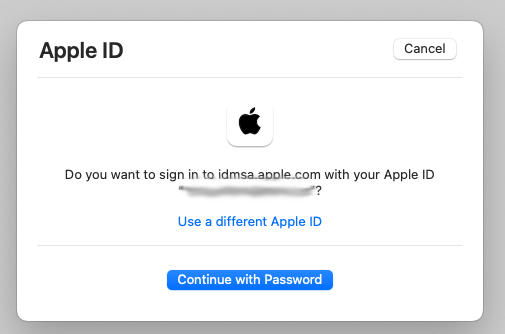
  • when you get the “Do you want to sign in to dims.apple.com with your AppleID?” window, click the blue “Continue with Password” button
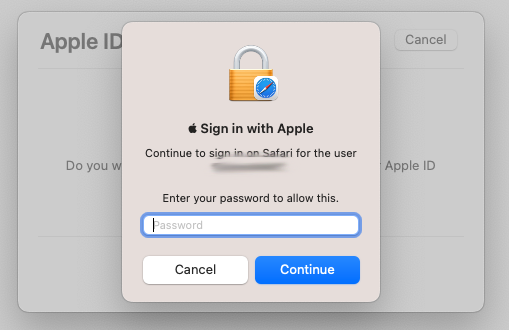
  • then you will get the “Sign in with Apple” window… and then, DO NOT enter your AppleID password !! ; you need to enter the password you use to unlock your Mac !!

…there is some (weird Apple) logic behind this, but it is completely unclear why Apple made this so confusing… [ Apple is asking for your password to unlock your passwords keychain in Safari ; but you will only get that from the text “Continue to login on Safari for the user” AFTER you have figured out some other way what the solution is… ]

On the other hand… that’s it !

enjoy πŸ˜‰